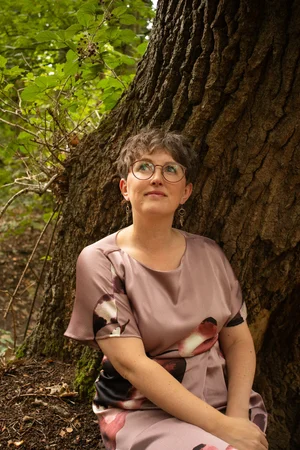
When I was younger I thought being highly sensitive was a problem to fix. I would push through, over-give and override what my body was telling me because the calendar said I should, or because everyone else seemed to manage just fine.
I don't do that anymore.
Realising I was highly sensitive was a powerful insight for me in my early 30s. Instead of continually working against my nature, I thought: what if I worked with it instead, leaned into it as a strength rather than a curse? What might happen?
To find out, I had to start listening to my body and my intuition, which meant getting really honest with myself. As I did, I realised I needed to reset my boundaries to honour my needs. I needed to change my lifestyle, and that included my working life. None of it happened overnight, it took time and conscious effort, but I made it happen. I had to learn to listen to myself as a highly sensitive person.
I’ve learned I simply can’t operate the same way as everyone else, not if I want to stay well mentally, physically and emotionally. For me, honouring my sensitivity isn’t a weakness. It’s practical, it’s realistic, and honest.
Over the years I've built my work life around what actually keeps me grounded, present, and able to serve well, rather than what I thought I should be able to handle. Here are some of the boundaries I've put in place. They protect me, and they protect my clients.
1. I work from home
Now, from a little cabin in the garden.
In my 20s, working in an office left me incredibly drained. As a dyslexic, and a highly sensitive, I need quiet to focus. I couldn't handle the constant chatter, the phone ringing, I couldn't hear my own thoughts. Other people's feelings, questions and thoughts were all draining to me. I'd come home completely exhausted, dreaming of working alone, without those disturbances.
Commuting drains me too. It pulls me out of myself before the day has even started, I'm not entirely sure why it tires me so much, possibly because I hate it that much. So I stopped forcing it. Working from home keeps my nervous system steady and my intuition clear, and it means I can put my energy where it's needed, my clients, my family, or content for the business.
To me, it's no sacrifice at all. I still speak to people regularly across my two client days and meetings, and my husband works from home too, so I get human contact every day.
I know having a cabin can look like a luxury, and I am lucky. But it wasn't handed to me, it was a vision more than seven years in the making. I knew what I needed, and I built toward it. Before the cabin, I worked from the living room for four years, so I was still able to have that solo time.
Don't aim for perfect straight away, you can make adjustments in small ways. Maybe for you that means not being in the office five days a week, and going in for three instead. Think about how you can make adjustments now, if you know this is something you need too. Get creative with your thinking.
2. I have two dedicated client days, and I stick to them
This prevents over-giving and burning out before I even notice it's happening.
What I learned in my Shiatsu practice was that clients would have me working on them at 7am in the morning and 9pm at night, if I let them. Once I became a mother, it became easy to be clear about my working hours, because my family was my number one priority. These are my hours. I'm not available outside them, because I have other commitments. Nice and clear.
It can be painful when a client is struggling, and I'll try to accommodate a regular where I can, but I can't always, if my diary is full. This is exactly why I'm clear with clients about booking regular slots: so they don't reach that point of desperation, and so there's no pressure on me to be available just because they haven't prioritised their own diary. The structure of regular appointments is about prioritising their wellbeing, because we all experience life stresses and need support.
It also protects my mental energy for the other parts of my work, I love to deep dive and focus on one thing at a time, rather than scatter myself across five. It means my focus isn't broken by hopping from holding space with a client to sitting down to write a blog post, because those require completely different parts of me. Also as a mum doing the school run, I have to be honest about my actual capacity, not the capacity I wish I had.
Two days, non-negotiable. That's the whole boundary.
3. I work online, not in person
I focus more deeply when I'm not absorbing the full intensity of someone's physical presence in a shared room.
When I was a Shiatsu practitioner, I'd be so incredibly drained after sessions. Looking back, I was still dealing with old trauma symptoms, and I've no doubt that played a part too. But I'm also incredibly somatically sensitive and clairsentient, and when I tune into someone's experience one-to-one, it's very easy for me to become flooded, not just by their physical sensations, but their mental and emotional state too.
One of the simplest ways I manage that sensitivity is by not seeing people in person. Interestingly, this doesn't apply to in-person group events, teaching or holding space for a room full of people doesn't flood me the way sitting close with one person does, and I'm grateful for that. When I trained in EFT, it was online, during Covid. That turned out to be a blessing, because I learned the work could be just as effective online, something I didn't believe before. It also helped me refine what I was picking up on, without being overwhelmed or flooded by it. It was revolutionary for me. From then on, I decided to work online only. The power of my work improved, and so did I.
I have lost work locally because of this, and I'm completely okay with that. Some people have been quite cross about it! But if someone's upset that I only work online, we're probably not a good fit, I'm not the right person for them, and that's okay. I'm not willing to compromise my wellbeing for proximity, or to give someone else what they want at my own expense.
4. I honour my capacity
If my energy is low, I don't push through it. I adjust. I rest, I nap, I move a meeting if I can. I protect the quality of my work instead of pretending I'm superhuman.
Now that I'm in my 40s, with an expanding business and a child to raise, I take my capacity very seriously, I don't want to burn out. It's a tricky one, because who I am in my business keeps evolving, and who I am as a person keeps stretching. Some of that is skill, I've trained myself to work quickly. Some of it is that my nervous system's capacity has actually changed. When I first started seeing clients online, I felt completely drained seeing four people in a week. Now I can see twelve and feel completely fine. But like building fitness at the gym, I've had to build that capacity through reps, over time.
The best way I manage my capacity is by not letting myself get close to burnout in the first place, so I'm strict, really strict, about my diary. But sometimes life throws unplanned family stuff at me, and that tips me into having too much on my plate. Or the run-up to Christmas is just mental, no matter how well I plan for it, so now I take an extra week off after Christmas just to decompress, because otherwise I stop functioning properly by January. I try to be realistic and honest with myself.
I'm learning to keep checking in and ask: is this beyond my capacity right now? Sometimes I get it right. Other times, life piles in unexpectedly and meditating isn't going to cut it, some days the honest answer is lying down and staring at the ceiling instead. That counts too.
5. I choose environments that support my sensitivity
Quiet. Spacious. Calm. Where I can, anyway, I'm a mother, and my daughter is pretty noisy at times! Children's parties are insanely loud and hyperactive!
So I make sure I get daily walks in the woods near my house, sometimes twice a day. I spend time in my garden, which I've cultivated to be a nourishing space. I get up early to have solo time to meditate and do exercise, or reflect so I feel nourished. My husband and I split the childcare, so I'm not "on" with the family all the time, and even when I'm doing chores, at least I can focus and be in my own head.
When I'm regulated, my clients get the best of me, not the leftovers. Looking after myself means I'm able to look after others effectively, my friends and family too. But it starts with getting honest with myself about my needs and my capacity as a highly sensitive person, and setting boundaries around that.
What I see with a lot of highly sensitive people is that they're still in people-pleasing mode, over-giving, not guarding their time and energy enough, not just to look after others, but to have the impact they actually want to have in the world.
Guarding your environment isn't precious. It's how the work gets done.
Over to You
These boundaries aren't barriers. They create clarity. They create safety. They give me capacity.
They're how I do my best work. If you're highly sensitive too, you're allowed to build your work life around what supports you, not what drains you.
But first, you have to let your intuition guide you, listen to your body and actually respond to the boundaries you already know you need, the big ones and the small ones. That can be brave, even life-changing work, realising who you really are, and what you really need.
You don't have to have it all figured out. You just have to start listening.
Have you started setting boundaries like this in your own life, to honour your sensitivity?