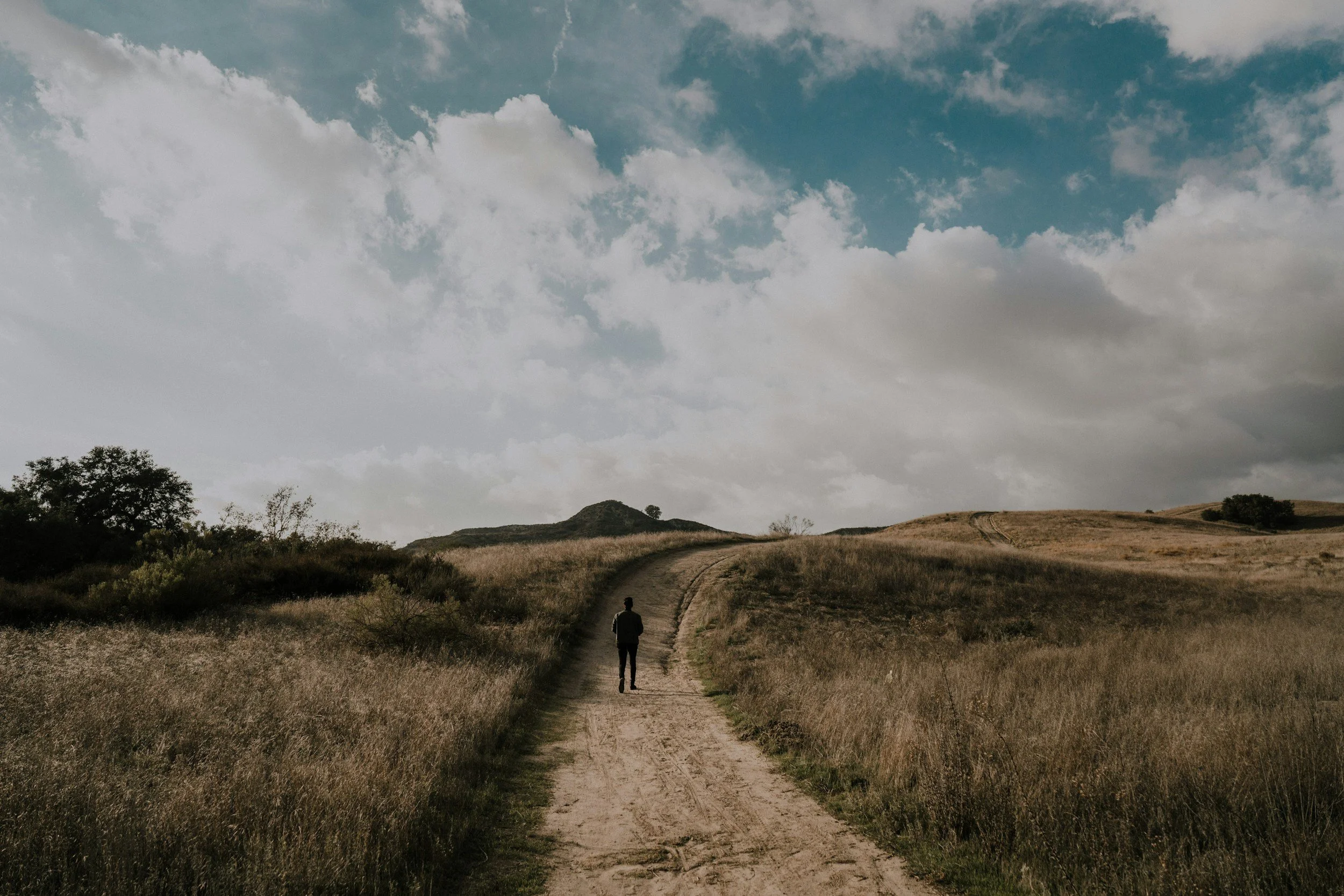
“Life is organic and it’s not linear… It’s a constant process of improvisation. You create your life as you move through it and you can recreate it.”
Most people try to follow a linear path. Maybe they know what they want to be by 30, they climb the ladder, they tick the boxes. And then there's the rest of us—the ones who feel like we're fucking up because we don't have it all figured out yet.
Here's what I want you to know: Not all of us know what we're meant to be doing by 40, and that's okay. I'm not where I thought I would be in my 40s. Not by far. This is the path for so many of us. This is normal.
I didn't think I would be spending 15 years healing from trauma, training, going through deep self-realization, and learning to actually listen to my intuition. It took me 40 years to realize I was an Intuitive Channel, to finally feel 'I was in the right place'—and I like to think of myself as pretty self-aware! Even then, I had to be told by a mentor.
Finding our life purpose takes time. Time to uncover who we are, develop our skills, and realize the gifts we're here to offer. Learning to follow our intuition is essential to this process.
For this reason, it's no surprise that the average age of entrepreneurs who start a business is 42, with peak success rates in their 40s and 50s. They've been developing their skills and are now often acting on gut instinct and vision. Starting later can have advantages. People who start earlier are the exception, not the rule.
The Inner Fight and Letting Go
Sir Ken Robinson agrees: Life is not linear—we can't plan it out, it's creative and organic. The greatest opportunities and biggest potentials can be found when we listen to our intuition over logic. But most of us will encounter much inner fighting when we start to listen to our intuitive guidance about the next step. Particularly if it's telling us to leave a job or project we have a lot of our identity wrapped into—even if our heart and energy are no longer in it.
For example, if you've been working in one industry you might think, "I've been working with food for 20 years. If I don't make something of it, I'm a failure."
That voice is fear talking. Fear of failure. Fear of letting go without having a plan. Fear of being visible in our not-knowing or our exploration. And underneath it all? All our insecurities. There can be a lack of self-worth, self-hatred, self-doubt, self-judgment. All of it can arise when we're standing at the edge of the unknown.
We want a plan. We want to have it figured out. We want to know what we're going to tell people we're doing when they ask.
But here's the thing: your intuition is your guide to uncovering your life purpose, and it doesn't work like that. Intuition just tells you to take the next step. Your soul has the vision—we have to trust it.
True Learning Happens Through "Failure"
Your higher self isn't bothered about the superficial successes of that project or career you've been pouring yourself into for 20 years. It's interested in the deeper learning and evolution that happened during that process.
What you've learned on your inner work journey is what prepares you to follow your true calling. Even the perceived failures or going down the wrong track can be a great education. You learn:
What it feels like to betray your intuition. To keep yourself small or build a business that doesn't feel aligned with your heart's longing.
What it feels like to follow someone else's path. Maybe you've learned from inspiring mentors who seemed to have it all figured out. You got caught up in their model, their enthusiasm, their way of doing things. But over time you realized their material, their approach—it wasn't ultimately for you. It was for them.
What it feels like to betray your boundaries. To suppress and ignore what you feel you know with a business partner. That feeling when you sense it won't work or that they're not to be trusted, but you override yourself anyway.
What it feels like to be out of alignment. To be in a relationship, job, or city that doesn't "feel" right.
And through it all? You've been evolving and learning lessons through experience. You've been doing personal growth work. The "failures," the detours, the years spent in the wrong place doing the wrong thing—they weren't wasted. They were teaching you how to recognize when you're finally on the right path.
So if you're in your 40s (or 30s, or 50s) and you still don't know what you're "supposed" to be doing, take a breath. You're not failing. You're learning. You're calibrating your intuitive compass. You're becoming the version of yourself who will know what to do next.
The Path Forward
So what if we start to listen to our intuition to find our life purpose? How does that work? We love a plan, don't we? We want to know all the steps laid out in front of us.
Meanwhile, the universe says, "Okay, take this track and keep going for the next 6 months to a year. Do the learning and self-development to know the next piece of the puzzle."
This is where trust comes into play—and that's not what we want to hear, is it? We want the whole answer, the entire vision, to know the goal. But you're not going to get it. It doesn't work like that. You simply get the next stepping stone.
So how do we use our intuition to find our life purpose? First, we have to trust this organic and non-linear path. We have to get familiar with and confident at listening to our intuition. Learning to live intuitively, in deep alignment with our higher self.
When you learn to stay open and follow your intuition, you'll be able to register when you're off track, when a boundary has been crossed, when a relationship doesn't "feel" right. You learn to trust what you feel in your gut rather than talk yourself out of it with logic. You'll have learned what it feels like to be in alignment with your intuitive compass.
Our intuition is the direct line to our higher self and our guides—they have the map to our life purpose.
With each intuitive step, we evolve into a different version of ourselves with a different perspective, and our life purpose gradually begins to take shape. Hazy at first, yet with time and intention it becomes clearer and more defined.
There is this deep sense of alignment—with the work, with the project, with the team, with the niche, with the people we serve, with the way we work, our modality, with our lifestyle, our routine, with our hobbies and passions, and so it goes on, as we start to listen to our intuition.
However, to get there we have to trust a feeling, a knowing, a hunch, a nudge—and walk in the dark with a flashlight, taking the next step, not knowing the full picture.
This is the work. Not having all the answers. Not knowing where you'll be in five years. Just following the next right step, even when it doesn't make sense to anyone else—sometimes especially when it doesn't make sense to anyone else.
Your life purpose isn't something you find like a destination on a map. It's something that reveals itself as you become more and more yourself. As you shed the layers of what you thought you should be and step into what you actually are.
So if you're feeling lost right now, or behind, or like you've wasted time—know this: you haven't wasted a thing. You're exactly where you need to be. The detours were necessary. The "failures" were lessons. And the fact that you're still here, still asking the questions, still willing to take the next step?
That's everything.
Trust the process. Take the next step. The vision is already there—your soul is holding it for you.